
Guide
What is an air handling unit and how does it work?
The air handling unit is the heart of the system that supplies a building with clean air at the right temperature and in the right quantity. This guide explains what is inside the unit, how the air is treated, which type of unit suits which building and what to look at when selecting one.
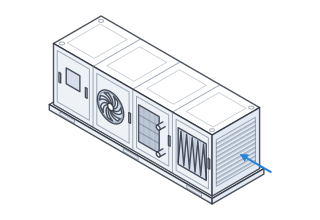
What is an air handling unit?
An air handling unit (AHU) is a device that prepares the air a building needs in one central place and distributes it to the spaces through ductwork. It filters the fresh air it draws in from outside, heats or cools it as required, adjusts its humidity and delivers it to the duct network with its fan. Most units also draw the stale air back from the space at the same time; part of this air is discharged outside and part is reused to save energy.
In short, an air handling unit combines ventilation and air conditioning in a single casing. While the wall-mounted air conditioners used in homes only cool or heat the air already inside a room, an air handling unit supplies the building with fresh air and brings that air to the required condition. In large and crowded buildings such as hospitals, shopping centres, factories, offices and hotels, it is the most orderly way of meeting the demand for clean air.
In brief
- It takes in fresh air, filters it, heats or cools it and distributes it through ducts.
- It draws stale air back from the space; part of it is discharged outside and its heat can be recovered.
- It is the centre of healthy and comfortable air in large and crowded buildings.
How does an air handling unit work?
The inside of the unit is made up of sections that the air passes through in turn. Each section applies one treatment to the air. The diagram below shows the path the air follows in a typical unit:
- Damper and mixing section. The dampers determine how much outside air and how much return air from the space enter the unit. In winter the return air can be mixed with fresh air to reduce the heating load.
- Filter section. Dust, pollen and particles are captured here. A coarse pre-filter is usually followed by a finer bag filter; in sensitive areas such as operating theatres, a HEPA filter is also fitted at the end of the duct.
- Heat recovery. The heat of the discharged air (or its coolness in summer) is transferred to the incoming fresh air by a plate heat exchanger or a rotary wheel. This is the section that reduces energy consumption the most.
- Heating coil. It raises the air to the required temperature using hot water from a boiler or heat pump.
- Cooling coil. It cools the air with chilled water or directly with expanding refrigerant gas; the moisture in the air condenses and is removed at the same time. The drain pan and droplet eliminator beneath it prevent water from being carried into the duct.
- Fan section. It pushes the treated air into the building, overcoming the resistance of the duct network. Today, high-efficiency EC fans or fans with variable-frequency drives, whose speed can be adjusted, are preferred.
- Silencer. It prevents fan noise from travelling through the ducts into the spaces.
If required, a humidifier, a second heater (reheat) or additional sections for acoustic and hygiene requirements are added to this sequence. On the extract side, there is a separate fan that discharges the air drawn from the space to the outside.
Where are air handling units used?
Air handling units are used wherever occupancy, heat load or air quality expectations are high:
- Hospitals: Operating theatres and intensive care units need filtered air with a controlled pressure balance; hygienic units are used here.
- Shopping centres and supermarkets: High occupancy and lighting loads call for continuous fresh air and cooling.
- Offices and tower blocks: To keep carbon dioxide low in meeting rooms and open-plan offices.
- Factories and production areas: To remove machine heat and the dust and odours produced by manufacturing, and to give workers clean air.
- Server rooms and data centres: To remove the heat generated by the equipment without interruption.
- Hotels, schools, sports halls, cinemas and theatres: For comfortable, clean air in halls where the number of people changes.
Types of air handling unit
Standard (modular) unit
The most common type, with sections selected to suit the requirement. Used in offices, shopping centres and factories.
Hygienic unit
A casing with easy-to-clean internal surfaces, no dead zones and high air tightness. For hospitals and clean rooms.
Heat recovery unit
Fitted with a plate or rotary heat exchanger; it lowers running costs by recovering the energy of the extract air.
Rooftop unit
A packaged unit with its own refrigeration circuit, placed on the roof. Preferred for large single-space stores and halls.
Swimming pool dehumidification unit
Removes moisture from the air in indoor swimming pools to prevent condensation and damage to the building.
100% fresh air unit
Uses no return air at all; for places such as laboratories and operating theatres where air must not be recirculated.
What to look at when choosing an air handling unit
The right unit is selected by calculation, starting from the needs of the building. The main values considered are as follows:
| Value | What it tells you |
|---|---|
| Airflow rate (m³/h) | How much air is supplied per hour. It is calculated from the number of people, the floor area and the type of use. |
| External static pressure (Pa) | The resistance created by ducts, grilles and filters. The fan is selected to overcome this resistance. |
| Fresh air ratio | How much of the air is taken from outside. In a hospital it can rise to 100%. |
| Heating and cooling capacity (kW) | The coil output needed to bring the air to the required temperature under summer and winter outdoor conditions. |
| Filter class | The particle size to be captured. ePM classes according to ISO 16890; HEPA according to EN 1822 in sensitive areas. |
| Heat recovery efficiency | How much of the energy in the discharged air is recovered. High efficiency means low running costs. |
| Casing classes | The casing's strength, air tightness and thermal bridging class according to EN 1886. |
| Sound level | The noise the unit and ducts will carry into the space. A silencer is added if necessary. |
The space where the unit will be placed also matters: the clearance to open the access doors for filter changes and maintenance, easy duct connections and keeping vibration from reaching the building should all be considered from the start.
Installation and commissioning
Even a well-chosen unit will not deliver the expected performance if it is installed incorrectly. The main points to watch during installation are:
- Placing the unit on a level base and on anti-vibration mounts,
- Making duct connections with flexible connectors so that vibration does not pass into the ductwork,
- Using a trap of the correct height on the cooling coil drain (otherwise water collects in the pan or the drain draws in air),
- Positioning the outside air intake and exhaust openings so that the discharged air is not drawn back in,
- At commissioning, setting the fan speed, measuring the airflow rates at the grilles and balancing them with the dampers.
At HSS Mekanik, we select and install air handling units and make the duct connections; we measure the system and hand it over in working order.
Frequently asked questions
What is the difference between an air handling unit and a split air conditioner?
A split air conditioner only cools or heats the air in the room where it is installed; it does not supply fresh air to the building. An air handling unit draws in fresh air from outside, filters and conditions it and distributes it to the whole building through ducts.
Is an air handling unit the same as a ventilation unit?
In everyday language the two terms are often used to mean the same thing. Technically, a device that only filters the air and supplies it with a fan is called a ventilation unit, while a device that also heats and cools the air and adjusts its humidity is called an air handling unit.
Is heat recovery really necessary?
Heating fresh air in winter and cooling it in summer takes a great deal of energy. Heat recovery takes a significant part of that energy back from the discharged air. The ecodesign rules in Europe also require heat recovery in two-way ventilation units.
When should filters be changed?
Rather than following a fixed calendar, the pressure difference between the front and back of the filter is checked. The filter is changed when the difference reaches the final value given by the manufacturer; this is why units are fitted with a filter pressure gauge.
Buildings that use air handling units
See the systems used in these applications, with drawings.