
Guide
What is a heat recovery unit and how does it work?
Bringing in fresh air means throwing out air that the building has already heated or cooled. A heat recovery unit wins back a significant part of that energy. In this guide we explain how the unit works, the types of heat exchanger, what efficiency really tells you, why bypass and frost protection are needed, and what to look at when selecting a unit.
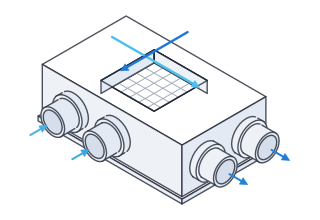
What is a heat recovery unit?
A heat recovery unit is a ventilation unit that transfers the energy of the air extracted from a space to the fresh air brought in at the same time. On the market it is also called a heat recovery ventilation unit or, by its abbreviations, an HRV (heat recovery ventilator); types that also transfer moisture are called ERVs (energy recovery ventilator). Inside the unit there are two fans, two filters and a heat exchanger in which the two airstreams pass side by side without touching.
A healthy indoor environment needs a constant supply of fresh air and the removal of stale air. The problem is that in winter the air that is thrown out has been heated, and in summer it has been cooled. If it is simply exhausted, that energy is lost and the cold or hot fresh air coming in has to be conditioned all over again. A heat recovery unit reduces this loss by passing part of the heat carried by the exhaust air to the incoming air. The heating and cooling load therefore falls without compromising the ventilation rate.
In brief
- It supplies fresh air to the space and extracts stale air; the two airstreams exchange energy in the heat exchanger without mixing.
- In winter it preheats the fresh air; in summer, when the outdoor air is warmer than the indoor air, it precools it.
- Types include plate, rotary wheel, run-around coil and enthalpy exchangers; the choice depends on the building and its use.
How does a heat recovery unit work?
The unit has two separate air paths: fresh air drawn in from outside and supplied to the space, and extract air drawn from the space and discharged outside. Inside the heat exchanger, these two paths run through channels separated by thin plates. The air on the warm side gives its heat to the plates, and the plates give it to the air on the cold side. The diagram below shows a typical compact unit with a cross-flow plate heat exchanger:
- Outdoor air filter. It catches dust and particles in the air drawn in from outside, protecting both the space and the heat exchanger from fouling.
- Heat exchanger. This is the heart of the unit. Fresh air and extract air pass through adjacent channels separated by thin plates; heat passes from the warm stream to the cold stream through the plates, and the two airstreams do not mix.
- Supply (fresh air) fan. It delivers the preheated or precooled fresh air leaving the heat exchanger to the space through the ductwork.
- Extract filter. It catches dust and fibres in the air drawn from the space. Its purpose is to keep the exchanger plates clean and to prevent efficiency from falling over time.
- Extract fan. It discharges the air drawn from the space, now that it has left its energy in the heat exchanger, to the outside.
There are also parts that are not shown in the diagram but are found in most units: a drain pan under the heat exchanger that collects condensed water, a bypass damper that takes the heat exchanger out of the airflow, a preheater against the risk of freezing, and a control panel that manages the fans and dampers. Where necessary, a final heating or cooling coil is added at the unit outlet to bring the fresh air to the required temperature. In large buildings, the heat recovery section inside the air handling unit (AHU) performs the same function.
Where is a heat recovery unit used?
Heat recovery makes sense in any heated and cooled space that needs a constant supply of fresh air. It is particularly preferred where ventilation through windows is inadequate, impossible or uncomfortable:
- Offices, meeting rooms and conference halls: It removes the carbon dioxide and odours that build up quickly in a crowd, while preventing heating and cooling energy from going to waste.
- Schools and libraries: It provides regular fresh air in classrooms and reading rooms without opening windows, so lessons and study are not interrupted.
- Shops, cafés and bars: It provides continuous air change for crowds that vary through the day and reduces uncontrolled air infiltration through doors and shopfronts.
- Hairdressers and dental clinics: It regularly exhausts chemical odours and stale air and supplies filtered fresh air in their place.
- Windowless rooms and basements: It supplies fresh air to spaces with no natural ventilation and prevents damp and odours from building up.
- Homes: In new, well-insulated and airtight buildings, compact units installed in the ceiling or a technical space are used to maintain indoor air quality.
Types of heat recovery exchanger
What really distinguishes one unit from another is the construction of the heat exchanger. Each type differs in efficiency, in how well it separates the airstreams, in size and in where it is used:
Cross-flow plate
The two airstreams pass between the plates at right angles to each other. It has no moving parts and is simple and durable; it is the type most often seen in compact units. Its efficiency is lower than that of the counter-flow type.
Counter-flow plate
The streams flow in opposite directions along a long path. Because heat exchange continues for longer, it gives the highest efficiency among plate types. It needs a longer casing and, because of its high efficiency, is more prone to freezing.
Rotary wheel (rotor)
A wheel with a thin aluminium honeycomb structure turns slowly, with one half in the extract duct and the other half in the fresh air duct; it carries the heat taken from the extract air to the fresh air side. Its efficiency is high, and types with a sorption coating also transfer moisture. Because a small amount of air passes between the two airstreams, it is not used where contaminated air must not be carried over.
Run-around coil
A coil is placed in each of the fresh air and extract ducts, and glycol-water is circulated between them by a pump. The two airstreams are completely separate and the ducts do not need to be side by side. Its efficiency is lower than the other types, but it stands out in hospitals, laboratories and systems added later to existing buildings.
Enthalpy (moisture-permeable) exchanger
Its plates are made of a special membrane that lets water vapour through; together with heat, it transfers part of the moisture. It reduces excessive drying of the indoor air in winter and the moisture load brought by humid outdoor air in summer. It is not suitable for spaces such as swimming pools, where the moisture has to be exhausted.
Heat pipe
Sealed tubes containing a refrigerant have one end in the extract duct and the other in the fresh air duct. It has no moving parts and no pump; the two airstreams are separate, but the ducts must be side by side.
Plate and heat pipe exchangers transfer only sensible heat (temperature); when condensation occurs on the extract side, the latent heat of that water is also used, but moisture does not pass to the fresh air. Enthalpy exchangers and wheels with a sorption coating transfer both heat and moisture, and so provide total energy recovery.
Efficiency, bypass and frost protection
Efficiency. The value looked at most in heat recovery is temperature efficiency: the ratio of how much the fresh air is warmed in the heat exchanger to the temperature difference between indoor and outdoor air. For example, if efficiency were 100 per cent, the fresh air would leave the heat exchanger at the indoor air temperature; in reality no unit reaches this value. Efficiency is not a fixed number; it changes with air velocity, the airflow balance between the two streams, and temperature and humidity conditions. Catalogue values should therefore be compared only if they were measured under the same test conditions. In Europe, the EN 308 standard is used for performance tests of air-to-air heat recovery units.
Bypass. Heat recovery is not wanted all the time. On summer nights or in the transitional seasons, when the outdoor air is cooler than the indoor air, warming this air in the heat exchanger would waste the chance to cool the space. A bypass damper routes the fresh air around the heat exchanger and supplies it directly to the space; this is called free cooling. Bypass is also used for frost protection and for regulating the heat that is recovered. In units with a rotary wheel, the wheel speed is usually reduced or the wheel is stopped instead of using a bypass. The EU Ecodesign Regulation for ventilation units (1253/2014) requires non-residential bidirectional ventilation units to have a bypass facility as well as heat recovery.
Frost protection. In winter, as the warm, humid extract air cools in the heat exchanger, its moisture condenses. If the outdoor air is cold enough, this water on the extract side freezes at the coldest corner of the exchanger; the ice blocks the channels, reduces efficiency and can damage the exchanger. The temperature at which freezing begins depends on the humidity of the indoor air and the efficiency of the exchanger. The main methods of protection are:
- Fitting an electric or water-based preheater at the fresh air inlet to raise the air entering the exchanger above the freezing limit,
- Routing part of the fresh air around the exchanger with the bypass damper,
- Temporarily reducing the fresh air flow rate; this method should be used with care because it creates negative pressure in the space,
- Reducing the speed of a rotary wheel, or, in a run-around coil, using a three-way valve to keep the temperature of the fluid going to the extract coil above the freezing limit.
Units with high efficiency cool the extract air further and are therefore more exposed to the risk of freezing. In cold climates, frost protection should be regarded not as an extra but as an integral part of the system.
What to look at when selecting a heat recovery unit
The right unit is selected based on the amount of fresh air the space needs and the conditions of the building. The main values to look at are:
| Value | What it tells you |
|---|---|
| Airflow rate (m³/h) | How much fresh air is supplied and how much air is extracted per hour. It is calculated from the number of people, the floor area and the type of use; keeping the two flow rates balanced is important for efficiency. |
| External static pressure (Pa) | The resistance created by ducts, grilles and external louvres. The fans must be able to deliver the required airflow against this resistance. |
| Temperature efficiency | How much of the heat in the extract air is transferred to the fresh air. It should be compared at the selected airflow and under the same test conditions. |
| Humidity efficiency | Only for units with an enthalpy exchanger or a sorption wheel; how much of the moisture is transferred. |
| Exchanger pressure drop (Pa) | The pressure the air loses as it passes through the exchanger. Large, closely spaced plate exchangers chosen for high efficiency can increase fan energy; the two are assessed together. |
| Fan power and control | EC fans with adjustable speed, and specific fan power (SFP). Airflow control based on a carbon dioxide or humidity sensor reduces energy use in unoccupied hours. |
| Leakage and separation of airstreams | How much of the extract air mixes into the fresh air. Where hygiene is required, a plate or run-around coil type is preferred. |
| Bypass and frost protection | Is there a bypass for free cooling, how is the freezing risk managed, and is a preheater needed? |
| Filter class | The class of the fresh air and extract filters according to ISO 16890. Finer filters are needed in areas with polluted outdoor air. |
| Sound level and size | The noise the unit and ducts will transmit to the space; whether the unit fits in the suspended ceiling or technical space. |
The position of the unit should also be considered from the start: the service hatches must be accessible for changing filters and cleaning the exchanger, there must be enough fall for the drain line, and it must be possible to connect to the outdoor air and exhaust openings with short ducts.
Installation and practical points
Even a well-selected unit will not deliver the expected efficiency if it is installed incorrectly. The main points to watch in practice are:
- Positioning the outdoor air intake and the exhaust discharge far enough apart, and facing different directions, so that the discharged air is not drawn in again,
- Covering the outdoor air and exhaust ducts that pass through heated spaces with vapour-barrier insulation; otherwise condensation forms on the outer surface of these cold ducts in winter,
- Connecting the exchanger drain with a trap and a fall, and protecting any drain line passing outside against freezing,
- Supplying fresh air to sitting, working and meeting areas, and extracting from dirty and humid spaces such as toilets and bathrooms,
- Not connecting the kitchen hood extract to the heat recovery unit; greasy air quickly fouls the exchanger and filters,
- Suspending the unit on anti-vibration mounts and making the duct connections with flexible connectors,
- Measuring and balancing the fresh air and extract airflows during commissioning; a unit that runs unbalanced loses efficiency and also creates an unwanted pressure difference in the space.
In its heat recovery installations, this is the aim of HSS Mekanik too: to transfer the heat of the air being exhausted to the fresh air coming in, and to reduce energy loss while ventilating the space.
Frequently asked questions
Does a heat recovery unit replace air conditioning?
No. The unit does not produce heat; it only transfers part of the energy in the extracted air to the fresh air. The temperature of the fresh air leaving the heat exchanger lies somewhere between the outdoor and indoor air temperatures. The space's heating and cooling needs are still met by a separate system or by a coil added at the unit outlet; heat recovery reduces this load.
Is it useful in summer too?
If the space is cooled and the outdoor air is warmer than the indoor air, yes: the cool air extracted from inside precools the hot fresh air coming in. With enthalpy exchangers, the moisture load brought by humid outdoor air is also reduced. When the outdoor air is cooler than the indoor air, the bypass comes into operation and the fresh air is supplied directly to the space without passing through the exchanger.
Does dirty extract air mix into the fresh air?
In plate exchangers the two airstreams are separated by plates; in a well-sealed unit very little passes across. In rotary wheels, some air is carried over as the wheel turns; to reduce this, a purge sector is used and the fans are positioned so that any leakage goes from the fresh air to the extract air. In run-around coil systems, the two airstreams never meet.
How is it maintained?
Filters are replaced based on the pressure difference or the unit's filter alarm rather than a fixed calendar. The exchanger is checked at intervals and cleaned as the manufacturer recommends, and the drain pan and trap are checked to make sure they are not blocked. A dirty filter or exchanger reduces both efficiency and the amount of air delivered.
Applications that use a heat recovery unit
See the systems used in these applications, with drawings.