
Guide
How is a commercial kitchen extract system installed?
In restaurant, hotel and canteen kitchens, the greasy vapour, heat and odour produced by cooking must be captured at source by a properly designed extract system. This guide covers the parts of the system from the hood to the roof fan, the fire risk, the make-up air supplied to replace the extracted air, and odour control.
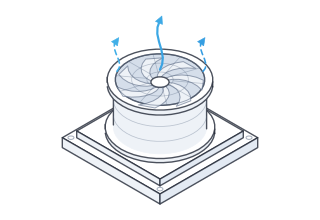
What is a commercial kitchen extract system?
A commercial kitchen extract system is a ventilation system that captures the hot, greasy and odorous air rising from cooking appliances at source and discharges it outside the building. Its main parts are the hood, grease filters, the extract duct and the extract fan. The complementary and often forgotten half of the system is the make-up air supplied to the kitchen to replace the air that is extracted.
It may look like the same job as a domestic kitchen extractor, but the scale and the risk are entirely different. In a commercial kitchen, hobs, grills, fryers and ovens run together for long hours, and the amount of heat, vapour and grease produced is very large. If grease builds up inside the duct, it becomes a serious fire hazard. A commercial kitchen extract system therefore has to be designed correctly not only for comfort, but also for fire safety and the health of the people working in the kitchen.
In brief
- The hood captures greasy vapour, heat and odour from cooking at source.
- Grease filters retain most of the grease; the duct and fan discharge the remaining air.
- If make-up air is not supplied to replace the extracted air, the system cannot achieve its intended airflow.
- Grease that builds up in the duct is a fire risk; the duct must be airtight, non-combustible and cleanable.
How does a kitchen extract system work?
Air heated during cooking rises as a column, carrying grease droplets, water vapour and odour with it. The job of the extract system is to capture this column before it disperses, separate the grease as early as possible and discharge the remaining air at a safe point. The diagram below shows the path the air follows in a typical kitchen:
- Cooking line. Hobs, grills, fryers and ovens are the source of heat, vapour and grease smoke. The type and power of these appliances are the biggest factor in determining the extract airflow.
- Hood. It collects the rising column of hot air. It must overhang the open edges of the appliances; otherwise, smoke escaping at the edges spreads into the kitchen.
- Grease filters and grease channel. Baffle filters set at an angle inside the hood change the direction of the air repeatedly, so that grease droplets are retained on their surfaces. The captured grease runs down into the channel below and the collection container.
- Extract duct. It carries the air that has passed through the filters to the fan. Fine grease that escapes the filters gradually builds up on the duct surfaces, so the duct material, airtightness and route are important for fire safety.
- Cleaning access doors. So that the inside of the duct can be reached and the accumulated grease removed, airtight access doors are fitted at bends, joints and at set intervals.
- Extract fan and discharge point. The fan overcomes the resistance of the filters and duct, draws the air and discharges it outside. Discharge is made at a point where odour will not return to neighbours or to the building's fresh air intakes, usually upwards from the roof.
- Make-up air. Fresh air is supplied to the kitchen to replace the air that is discharged. This air is delivered at low velocity and from suitable points so that it does not disturb the capture of the hood.
The system only works correctly if these parts are calculated together. A powerful fan does not make up for a small hood or for missing make-up air; in most cases it only increases noise and energy consumption.
Where is commercial kitchen extract used?
Extract at source is needed in every kitchen where food is cooked on a commercial scale and grease and vapour are produced:
- Restaurants and eateries: for cooking lines that produce a lot of grease and smoke, such as grilling, kebabs and frying.
- Hotel kitchens: for large kitchens that operate all day and have several cooking sections.
- Canteens and catering kitchens: for the heavy vapour from large cooking kettles, steam cookers and the dishwashing area.
- Bakeries and patisseries: to discharge the heat and vapour from ovens without letting them spread into the product area.
- Food production facilities: above cooking, frying and boiling lines, to keep the air in the production area clean.
Hood types
The hood is selected according to the layout of the appliances and the load they produce. The main types are as follows:
Wall-mounted hood
Fitted above a cooking line placed against a wall. Because the back is closed by the wall, smoke can only escape from the front and side edges; for the same line, it is generally the type that works with the lowest airflow.
Island hood
Suspended above cooking islands in the middle of the kitchen that are open on all four sides. Because it is more exposed to surrounding air currents, it needs a higher extract airflow than a wall-mounted hood.
Condensate (vapour) hood
For appliances that produce only vapour, not grease, such as dishwashers and boiling kettles. Instead of a grease filter, it has a construction that lets the vapour condense and be collected.
Ventilated ceiling
An extract and supply system integrated into the whole or part of the kitchen ceiling instead of a hood. It is generally used in large kitchens where a high standard of hygiene is expected.
Hoods with additional filtration
Hoods that have UV-lamp or water-wash sections in addition to the baffle filter. They are preferred in heavily used kitchens to reduce the amount of grease passing into the duct.
Whichever type is chosen, the hood is made of a non-combustible, easily cleaned material such as stainless steel, and its filters are positioned so that they can be removed and washed by hand.
Grease filters, extract duct and fire risk
Kitchen fires usually start at the cooking appliance; however, once the flame reaches the hood and a duct with accumulated grease, the fire can travel along the duct and spread to other parts of the building. Grease management is therefore the most important design issue in a commercial kitchen extract system.
Grease filters. Stainless steel baffle filters are the standard in commercial kitchens: as the air changes direction between the filter blades, grease droplets strike and cling to the surface and run down. Cyclone-type filters work in a similar way by spinning the air. The wire mesh filters found in domestic extractors are not used on their own in commercial kitchens, because they hold the grease inside and clog easily. Filters separate grease but do not retain all of it; the duct must therefore still be cleanable.
Extract duct. A greasy extract duct is kept separate from the other ventilation ducts in the building and is built according to the following principles:
- It is made of non-combustible material (steel) and liquid-tight, with joints that are welded or sealed,
- No low points are left where grease could collect; horizontal sections are given a fall towards the hood or a collection point,
- An air velocity is chosen that reduces grease settling in the duct without excessively increasing noise and pressure loss,
- Where it passes through other spaces, it is protected inside a fire-resistant shaft or with fire insulation and is kept away from combustible materials,
- Flexible duct and insulation whose inner surface would retain grease are not used.
An automatic fire suppression system for the hood and the duct entry (usually a wet chemical type) is required in many projects. Interlocking the gas supply so that the hobs cannot be lit unless the extract fan is running is also a common safety measure; the requirements of the gas distribution company are consulted on this. In Türkiye, the Regulation on Fire Protection of Buildings (Binaların Yangından Korunması Hakkında Yönetmelik) and local fire brigade requirements apply; on international projects, sources such as NFPA 96 in the USA and the EN 16282 series in Europe are also consulted.
Make-up air to replace the extracted air
When thousands of cubic metres of air per hour are extracted from a kitchen, the same amount of air has to enter from somewhere. If there is no separate make-up air system, air is drawn in through gaps around doors, through windows and even through flues. As a result, the kitchen falls into excessive negative pressure: doors are hard to open or slam, whistling noises are heard, the fan cannot achieve its intended airflow and the hood cannot capture the smoke. Dangerous situations such as flue gas spillage from natural-draught appliances can also occur.
For this reason, the extract system is always designed together with a make-up air system. The points paid attention to in practice are:
- The make-up air flow rate is kept slightly below the extract, so that the kitchen stays at a slightly negative pressure relative to the dining area and odour does not spread into it,
- Make-up air is supplied at low velocity and is not blown towards the hood; high-velocity air jets disturb the rising column of smoke and make it escape from the hood,
- In winter the make-up air is heated and, if required, cooled in summer; untreated cold air makes working in the kitchen difficult,
- The make-up air intake is placed away from the extract discharge point so that the discharged greasy air does not re-enter.
Odour control
Odour from kitchen extract is a common problem, especially for businesses in residential areas and shopping centres. The first and most effective measure is choosing the discharge point correctly: the extract should discharge upwards, above roof level, away from windows and fresh air intakes.
Where the discharge point is not enough, the extract air is treated. Electrostatic precipitators (ESP) capture fine grease and soot particles in the smoke. Activated carbon filters bind odour molecules on their surface; however, because grease quickly renders the carbon unusable, good particulate treatment must always be installed ahead of it. UV and ozone units are also used to reduce odour. Whichever method is chosen, the effectiveness of the treatment units depends on regular cleaning and filter replacement; a neglected unit both fails to retain odour and reduces the fan's airflow.
What is considered in the design?
A kitchen extract system is sized by calculation, starting from the kitchen's menu and appliance layout. The main values considered are as follows:
| Value | What it tells us |
|---|---|
| Type and power of the cooking appliances | Grills, fryers, woks and charcoal hobs produce far more heat, grease and smoke than boiling kettles. This is the basis of the extract load. |
| Extract airflow (m³/h) | The amount of air the hood needs to draw. It is calculated from the appliance load and the hood type and size; in Europe, the VDI 2052 guideline is often used for this calculation. |
| Hood size and overhang | How far the hood extends beyond the open edges of the appliances and its height above them. It directly affects capture efficiency. |
| Filter type and quantity | The airflow each filter can pass is limited by manufacturer data. Too few filters mean high pressure loss and poor grease retention. |
| Duct cross-section and route | A velocity that prevents grease from settling, a short route with few bends, and access for the cleaning doors. |
| Fan pressure and temperature rating (Pa, °C) | The fan must overcome the resistance of the filters, the duct and any treatment unit, and be able to run continuously in hot, greasy air. |
| Make-up air flow rate and conditioning | Supply air balanced against the extract, heated in winter and cooled in summer if required. |
| Odour and discharge conditions | The location of the discharge point, neighbouring buildings and any odour treatment unit to be added if required. |
Extract fan selection. The fan used in a kitchen extract system must be suitable for hot, greasy air: preferred fans have the motor outside the airstream or rated for high temperature for this duty, a casing that can be cleaned and a grease drain outlet. On the roof, centrifugal roof fans that discharge the air upwards or box-type fans are generally used. Because cooking intensity varies greatly during the day, fans are often driven by a frequency inverter; demand-controlled systems that adjust the airflow to the load using temperature and smoke sensors achieve significant energy savings in both the extract and the make-up air.
Installation and application notes
In a kitchen extract system, workmanship on site is just as decisive as the calculation. The main points checked during installation are:
- Hanging the hood at the correct height relative to the appliances and overhanging all open edges, and positioning the filters so they can be removed easily,
- Joining the duct airtight, maintaining the fall and leaving no low points where grease could collect,
- Fitting cleaning access doors at bends and at suitable intervals, and always providing an access panel for doors that end up above a suspended ceiling,
- Applying fire insulation or the shaft fully wherever the duct passes through other spaces,
- Seating the fan on anti-vibration mounts, connecting the grease drain to a collection container and providing safe access to the fan for maintenance,
- At commissioning, measuring the hood airflows, checking capture with a smoke test and balancing the make-up air against the extract.
Cleaning access must be considered at the design stage: a duct with no access doors, one that is enclosed inside the ceiling or one with many bends cannot be cleaned in practice and in time becomes a fire risk. Washing the filters frequently, and having the duct and fan cleaned regularly according to the intensity of use, is the responsibility of the operator.
At HSS Mekanik, we remove greasy vapour, heat and odour at source in kitchens with a hood, extract duct and fan, and supply make-up air to replace the extracted air.
Frequently asked questions
Why is the hood not drawing the smoke?
The most common causes are insufficient make-up air, clogged grease filters, a hood that is smaller than the appliances or mounted too high, and air currents blowing towards the hood (such as an open door or a badly positioned supply grille). These points should be checked before the fan is increased in size.
Can kitchen extract be connected to the building's other ventilation ducts?
No. A greasy extract duct is installed as a separate system so that fire and odour do not spread through the building; it is not combined with toilet, office or general extract ducts.
Can extract be installed without supplying make-up air?
At small airflows, air may enter through gaps, but in commercial kitchens this is generally not enough. The kitchen falls into excessive negative pressure, the fan airflow drops, doors become hard to open and there is a risk of spillage from natural-draught flues. Extract and make-up air must be designed together.
How often should grease filters be cleaned?
There is no fixed interval; it depends on the type and intensity of cooking. In kitchens that grill and fry, filters are washed very frequently, often daily or weekly. Visible grease build-up on the filter and weaker capture by the hood are signs that cleaning is due.
Applications that use kitchen extract
See the systems used in these applications, with drawings.