
Guide
Enclosed car park ventilation and jet fan systems
In enclosed car parks, vehicle exhaust builds up, and in a fire the smoke can fill a whole level within minutes. In this guide we explain how a jet fan system moves air, how everyday ventilation differs from fire mode, what the system is made of and what is considered at the design stage.
What is enclosed car park ventilation?
In enclosed car parks, whether in basements or inside a building, the gases from vehicle exhausts cannot leave on their own. Carbon monoxide (CO) from petrol engines and nitrogen dioxide (NO₂) from diesel engines are odourless or barely noticeable, yet harmful to health; they build up especially in the morning and evening, when vehicles enter and leave in large numbers. Enclosed car park ventilation is the mechanical system that removes this polluted air and brings in fresh air to replace it.
The second task of the same system, and at least as important, is fire. When a vehicle burns in a car park, the hot, dense smoke spreads quickly beneath the low ceiling, blocks visibility and tries to reach escape routes and staircases. In this situation the ventilation system switches to fire mode: it carries the smoke in a set direction and extracts it, makes it easier for the fire service to approach the fire, and clears the level of smoke after the fire.
There are two basic ways of doing this: a ducted system, which works with extract and fresh air ducts running along the ceiling, and a jet fan system, which uses fans suspended from the ceiling to push and carry the air instead of ducts. Today most enclosed car parks use a jet fan system because it takes up less space.
In brief
- In everyday operation it dilutes the CO and NO₂ from vehicle exhausts and extracts them to the outside.
- In a fire it carries the smoke in a set direction, assisting evacuation and the fire service.
- Jet fans push the air along the car park to the main extract point without using ducts.
How does a jet fan system work?
A jet fan system is based on the principle of longitudinal flow. Fresh air enters at one end of the car park, while the main extract fans draw the air out at the other end. The large volume in between cannot be expected to follow this path on its own; in corners and behind columns there remain stagnant zones where gas collects. This is exactly where jet fans come in: these fans, suspended beneath the ceiling, produce a high-velocity jet of air that also entrains the surrounding air and carries it along. Fans placed one after another keep this movement going from one end of the car park to the other, so that the whole level behaves like a single mass of air flowing towards the extract point.
- Fresh air intake. Fresh air usually enters through vehicle ramps and external openings. If these openings are not sufficient, or if the car park extends over several basement levels, fresh air shafts and fresh air fans are used.
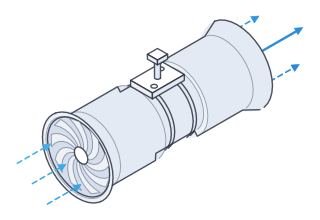
- Jet fans. These are ductless fans suspended beneath the ceiling. They push the air to direct the flow towards the extract point and ensure that no dead zones remain. They are selected to run at low speed in everyday operation and at high speed in a fire.
- CO and NO₂ sensors. Gas sensors distributed at different points in the car park continuously measure the CO and NO₂ levels in the air. The system operates on these readings; when gas levels are low, the fans stay off or turn slowly.
- Main extract fans. These are the fans that discharge the air out of the building through the extract shaft. Since they will also carry hot smoke in a fire, they are selected as smoke extract fans able to run for a specified time at high temperature.
- Control panel. It starts the fans, adjusts their speeds according to signals from the sensors and the fire detection system, and applies the predefined scenario in a fire.
The air drawn out on the extract side and the fresh air coming in must be in balance. The car park is generally kept at slightly negative pressure relative to the rest of the building, so that exhaust gas and smoke flow towards the extract point rather than into staircases and lift shafts.
Everyday ventilation and fire mode
A jet fan system performs two different duties with the same equipment. These two modes of operation are managed with entirely separate logic.
In everyday ventilation, the aim is to keep exhaust gases below the level that harms health. Running the fans at full power all day wastes energy and makes noise; for this reason the system runs only as much as needed, according to the sensors. As gas levels rise the fans start in stages or speed up, and when levels fall they slow down again. In hours of light vehicle traffic the system often stays on standby.
In fire mode, the gas value measured by the sensors no longer matters; the fire detection system takes control. A scenario defined according to the zone where the fire is detected comes into operation: the main extract fans go to high speed, the jet fans work to push the smoke towards the extract point and, if necessary, some fans are stopped or the direction of reversible fans is changed, depending on the fire zone. The aim is to confine the smoke to one part of the car park and leave a smoke-free path on the other side from which the fire service can approach the fire.
There is one point to be careful about here. In the first minutes of a fire, the hot smoke remains as a layer beneath the ceiling, and visibility below it can stay clear. If jet fans are run early and at high speed, they can stir this layer and bring the smoke down to floor level. For this reason, when the fans start, in what order and at what speed are decided at the design stage, considering the evacuation time and how the fire service will respond. The British standard BS 7346-7 treats different design objectives for enclosed car parks separately, such as clearing smoke after a fire and smoke control to assist the fire service.
Where are jet fan systems used?
Jet fans are used where air has to be carried in one direction along a long space:
- Residential and housing-estate car parks: for exhaust gas removal and smoke control in a fire in basement car parks.
- Car parks of shopping centres, hotels, hospitals and office buildings: in large car parks spread over several levels, where vehicle traffic is heavy throughout the day.
- Multi-storey car parks: on enclosed or semi-enclosed levels where natural ventilation is not enough.
- Bus stations and vehicle areas: in enclosed areas where buses and vehicles wait with their engines running.
- Road and rail tunnels: to carry exhaust gas, and smoke in a fire, along the tunnel; larger-diameter jet fans are used in tunnels.
Jet fan types and system options
Axial jet fan (unidirectional)
The classic type, with a cylindrical casing and a silencer at each end. It pushes air in one direction only and suits car parks where the flow direction will never change.
Reversible jet fan
The impeller is designed to produce thrust in both directions. It is used in scenarios where the flow direction has to be changed depending on the location of the fire.
Induction-type (low-profile) jet fan
A type with a centrifugal fan and a flat casing. Because it fits into little height, it is preferred in car parks with low, beamed ceilings.
Ducted system
Extract and fresh air are taken and supplied through ducts and grilles running along the ceiling. It can be used in small or heavily compartmented car parks where jet fans are not suitable.
Natural ventilation
On car park levels with sufficiently open sides, the air is renewed on its own through the openings. In enclosed car parks it is not sufficient by itself.
Two-speed and variable-speed fans
The fans are driven by a two-speed motor or a frequency converter. Low speed is reserved for everyday ventilation and high speed for fire mode.
Jet fans or a ducted system?
In a ducted system, large-section extract ducts are run along the ceiling so that air can be collected from every point of the car park. These ducts take a significant share of the floor-to-ceiling height; they clash with sprinkler pipes, lighting and cable trays, and may limit vehicle headroom. In a jet fan system, by contrast, there are no ducts in the car park area; only the extract and fresh air shafts remain, together with the main fans connected to them.
- Space and height: Jet fans use only certain points of the ceiling; the height that ducts would occupy is gained.
- Coordination: There is far less clash with sprinkler, electrical and lighting installations.
- Air movement: In a ducted system the air is drawn in through grilles, and movement can be weak in areas far from the grilles; jet fans create a flow that sweeps the whole volume.
- Fire scenario: With jet fans, the direction of the smoke and the zone in which it is confined can be controlled; on the other hand, setting up and commissioning the scenario correctly demands more engineering.
- Noise: Because jet fans operate inside the space, noise must be considered in the design; models with silencers are selected, especially for car parks beneath residential buildings.
Jet fans are not the best solution in every car park. In car parks that are very small, divided into sections by columns and walls, or where the flow cannot be established from one end to the other, a ducted system, or a combination of the two systems, may give a better result.
What is considered in design? CFD analysis
A jet fan system is designed by calculation, based on the plan of the car park and the fire scenario. The main points considered are as follows:
| Topic | What it covers |
|---|---|
| Car park geometry | Level area, ceiling height, beams, columns and ramps. Beams and walls can block the path of the jet and disrupt the flow. |
| Airflow rate (m³/h) | Calculated separately for everyday ventilation and fire mode. The main extract and fresh air fans are selected according to this airflow. |
| Jet fan thrust (N) | The thrust the fan imparts to the air. It determines the number of fans required and the distance between them. |
| Smoke zones | The zones on which fire detection and fan scenarios will be based; which fan will operate and how in which fire. |
| Fan temperature class | Fans that will run in a fire are classified according to EN 12101-3; classes such as F300 and F400 indicate that the fan can operate at a given temperature for a given time. |
| Fresh air path | Whether ramps and openings are sufficient; if not, the location of the fresh air shaft and fan. |
| Sensor layout | Distributing CO and NO₂ sensors so that they represent the areas where vehicles are present and people walk. |
| Power supply | A standby supply and fire-resistant cabling so that power to the fans is not lost in a fire. |
| Noise level | The noise the fans will carry into the car park and adjoining spaces; a silenced model if necessary. |
The flow created by jet fans cannot be predicted accurately with simple formulae such as those used for duct calculations; columns, beams, ramps and parked vehicles affect the flow differently in every car park. For this reason the design is verified by CFD (Computational Fluid Dynamics) analysis. A three-dimensional model of the car park is built on a computer, the fans are placed in it and the movement of the air is calculated. For everyday ventilation, the velocity distribution and the dead zones where gas may collect are examined. For the fire scenario, a specified fire size is defined and the spread of smoke, visibility distance and temperature are examined over time; software such as FDS (Fire Dynamics Simulator), developed by NIST, is widely used in this type of analysis.
According to the CFD results, the position, direction or number of fans is changed and the analysis is repeated. The point not to forget is this: CFD is a verification tool, and its result is only as accurate as the fire size, scenario and model entered. If the actual situation on site does not match the model, for example if a beam or ceiling element added later blocks the path of a jet, the analysis must be updated for this change.
Installation and commissioning
The success of a jet fan system depends on the fan layout in the design being applied exactly on site and on the scenario being tested correctly. The main points considered during installation are:
- Hanging the jet fans securely from the structure, with vibration isolation and the suspension system specified by the manufacturer,
- Leaving no obstacles in front of or behind the fans, such as beams, ducts or signs, that would block the jet,
- Checking the fan directions against the project; a fan installed the wrong way round can disrupt the whole flow,
- Running the power and control cables of fans that will operate in a fire with fire-resistant cables,
- Placing the sensors at the positions and heights shown in the project and checking their calibration at commissioning,
- Connecting the control panel to the fire detection system and testing the scenario for each fire zone one by one,
- Measuring the extract and fresh air flow rates at commissioning, and verifying the direction and speed of the jet fans on site.
At HSS Mekanik, we install jet fan systems in enclosed car parks that remove exhaust gas and keep smoke under control in a fire.
Frequently asked questions
Can a jet fan system extract smoke on its own?
No. Jet fans only carry the smoke; it is the main extract fans, connected to the extract shaft, that discharge it out of the building. In addition, fresh air must be able to enter to replace the air that is discharged. Jet fans, main extract fans, the fresh air path and the control panel work together as a single system.
Why don't car park fans run all the time?
Everyday ventilation is provided only as much as needed, according to the sensors. When the CO and NO₂ levels in the air are low, running the fans at full power wastes energy and makes noise. When gas levels rise, the fans start automatically; when a fire signal is received, the fire scenario runs independently of the sensors.
Why are both CO and NO₂ sensors used?
Carbon monoxide is more prominent in the exhaust of petrol vehicles, and nitrogen oxides in that of diesel vehicles. Because both kinds of vehicle enter the car park, the two gases are monitored separately. In car parks that admit LPG vehicles, LPG detectors placed close to the floor, since LPG is heavier than air, can also be used.
Is CFD analysis mandatory for every jet fan project?
Because the flow created by jet fans depends heavily on the geometry of the car park, CFD analysis is the most reliable method, particularly for verifying the fire scenario. The documents and analyses required by the authority that will approve the project should also be clarified at the start of the project.
Where jet fans are used
See the systems used in these applications, with drawings.